System Type: Open-loop condenser water system
Application: Chiller condenser tubes (cooling water side)
Facility: Data Center
Lay-Up Type: Dry (no water left in tubes)
- Objective
- To prevent corrosion, biological fouling, and scaling inside condenser tubes and piping during extended shutdown of the chiller condenser circuit.
- Materials and Equipment
- Compressed air or nitrogen (oil-free, dry)
- Non-oxidizing biocide (e.g., isothiazolone or DBNPA)
- Corrosion inhibitor (e.g., filming amine or vapor-phase inhibitor)
- Spray nozzles or foggers (if using VCI)
- Clean lint-free cloths or swabs
- PPE (gloves, goggles, etc.)
- Labels and tags
- Procedure
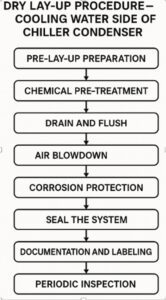
- Pre-Lay-Up Preparation
- Notify operations staff and isolate the chiller condenser from the system.
- Confirm pump lockout and tag all valves and power sources.
- Check water chemistry (record pH, conductivity, microbiologicals if possible).
- Chemical Pre-Treatment (Optional but Recommended)
- Dose the system with a non-oxidizing biocide at shock levels (e.g., isothiazolone at 300–500 ppm or DBNPA at 300 ppm).
- Circulate for 2–4 hours to kill existing planktonic organisms and treat biofilm.
- Drain and Flush
- Completely drain the condenser tubes and associated piping.
- If debris or scale is suspected, flush with clean water or soft water to remove sediment.
- Remove water from low points using pumps or manual methods.
- Air Blowdown
- Use dry, oil-free compressed air or nitrogen to blow out residual water in tubes and headers.
- Blow until all condensate and visible moisture are eliminated.
- Special attention to horizontal piping and dead legs.
- Corrosion Protection
- Choose one of the following:
- Vapor-Phase Corrosion Inhibitor (VCI) Fogging
- Apply a VCI fogging agent (e.g., Nalco 7978 or equivalent) into condenser tubes and headers.
- Choose one of the following:
- Seal system afterward to retain vapors.
- Filming Amine Spray
- Spray or fog with a filming amine (e.g., DEHA, morpholine, or Nalco-specific filming agent).
- Coat all exposed metal surfaces.
- Seal the System
- Cap or seal all flanges, drains, and vents to prevent humid air or insects from entering.
- Apply desiccant bags in openings if desired.
- Documentation and Labeling
- Tag the equipment:
“Dry Lay-Up – Do Not Fill or Start – Date: [MM/DD/YYYY], Chemical: [Name]” - Record lay-up procedure, chemicals used, and date in maintenance log.
- Tag the equipment:
- Periodic Inspection
- For lay-ups longer than 3 months
- Open an access point and inspect every 30–60 days for signs of corrosion, moisture, or odor.
- Re-fog or retreat if humidity breach is suspected.Recommissioning
- Prior to startup:
- Remove seals/caps
- Visually inspect internal surfaces
- Flush system with clean water
- Test for corrosion products (e.g., Fe, Cu)
- Re-establish water treatment before resuming operation
- Prior to startup: